| The Comedy of Errors | ||||
|---|---|---|---|---|
 |
|
|||
 |
 |
|||
A |
L |
|||
| Plot Summary: | |
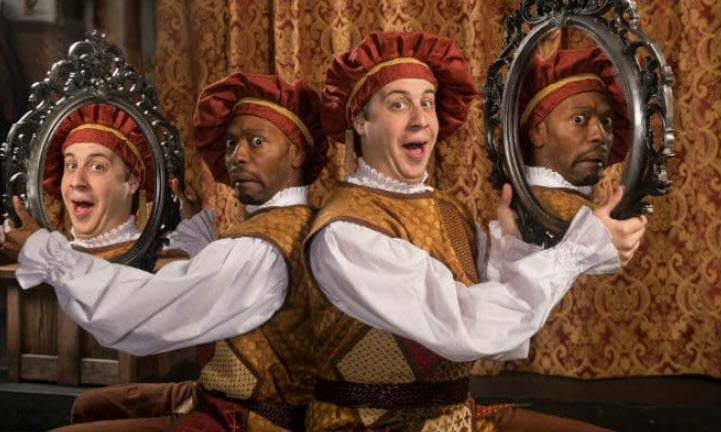
The Comedy of Errors is a fast-paced farce centered on mistaken identity. The play begins with Egeon, a merchant from Syracuse, who is arrested in Ephesus for violating a law banning travel between the rival cities. He explains that he is searching for his lost wife and one of his twin sons, both separated from him in a shipwreck years ago. Unknown to Egeon, both of his sons—identical twins named Antipholus—and their identical twin servants, both named Dromio, are now in Ephesus. As the play unfolds, the visiting Antipholus of Syracuse and his servant Dromio are constantly mistaken for their Ephesus counterparts. This leads to a series of comedic misunderstandings involving money, jewelry, arrests, and accusations of madness and infidelity. Antipholus of Ephesus is locked out of his own home, while his wife believes he’s acting erratically. Meanwhile, Antipholus of Syracuse begins to fall for Adriana’s sister, Luciana. Eventually, the confusion reaches a climax at a priory, where all four twins come face to face. Their true identities are revealed, Egeon is reunited with his family, and misunderstandings are cleared up. The play ends joyfully with reconciliations and celebrations.
|
|
 |
 |
|||
|---|---|---|---|---|
| P | A |
| Main Characters and Their Roles: | |
Egeon – A merchant from Syracuse and father of the Antipholus twins. His quest to find his lost family sets the play in motion. Emilia (Abbess) – Egeon’s long-lost wife who has become the abbess of a priory in Ephesus. She is reunited with her family at the end Antipholus of Syracuse – One of Egeon's twin sons. He arrives in Ephesus searching for his brother and is confused by the locals’ strange behavior. Antipholus of Ephesus – The other twin, raised in Ephesus. A respected citizen, he is bewildered when people accuse him of actions he didn’t commit. Dromio of Syracuse – Servant to Antipholus of Syracuse. Comedic and loyal, he is repeatedly mistaken for his twin. Dromio of Ephesus – Servant to Antipholus of Ephesus. Also humorous, he is caught up in the escalating chaos. Adriana – Wife of Antipholus of Ephesus. She is jealous and confused by her husband's odd behavior (actually caused by mistaken identity). Luciana – Adriana’s sister. Antipholus of Syracuse falls in love with her, mistaking her for someone he is not supposed to love Duke Solinus – The ruler of Ephesus. He initially condemns Egeon to death but later pardons him when the truth is revealed. Balthazar – A merchant who advises Adriana to be cautious when confronting her husband Angelo – A goldsmith in Ephesus who gives a chain to the wrong Antipholus, triggering more confusion. Doctor Pinch – A conjuring schoolmaster called to diagnose the supposed madness of Antipholus of Ephesus. A Courtesan – A woman of Ephesus who claims Antipholus owes her a ring, adding to the tangle of mistaken identity. Second Merchant – A merchant to whom Angelo owes money; he gets caught up in the debt confusion.
| |
| Quotes: | |
|
|
 |
|
Key events in each act: |
|
Act 1:
Act 2:
Act 3:
Act 4:
Act 5:
|
|
|---|
| Cast: | |
|